
Blog

Increasing Your Productivity

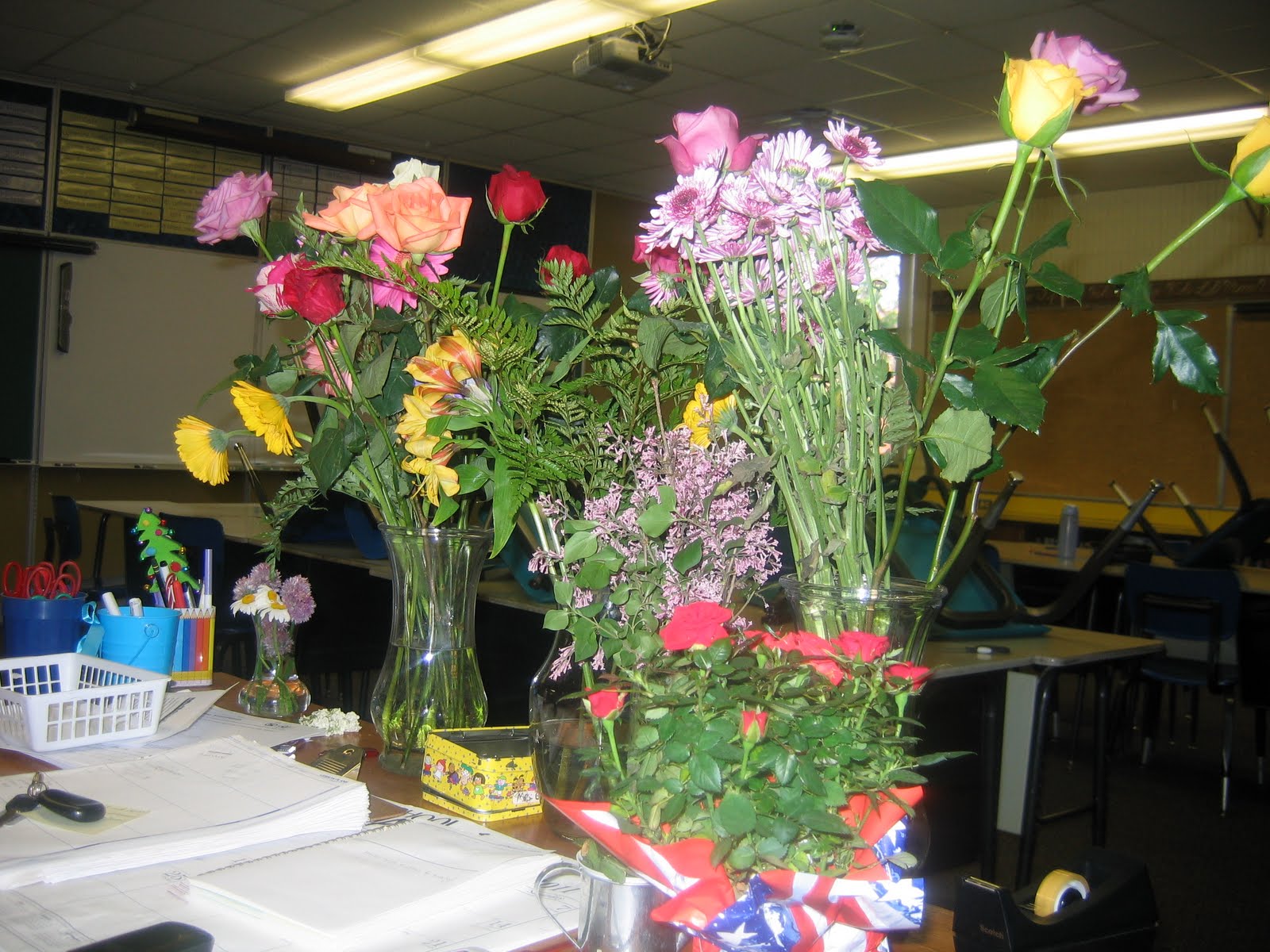
My students surprised me on Thursday. They made me a really touching power point and they all brought flowers (hence the picture). I about cried. It was the sweetest thing. Especially since they organized it on their own.

Anyway, I’m leaving.

I’m setting out on a new adventure.

Today is my last day in the classroom.

Maybe temporarily. Maybe permanently. Who knows. The fact is, when August rolls around and my coworkers and friends are getting back into the classroom, putting up bulletin boards and figuring out class lists, I won’t be joining them.

It’s bittersweet.

I’ll miss the students. I will really miss the students. Especially this year’s class. A class of writers and goofballs. Kids with quick smiles and contagious laughs. They wound their way into my heart in such a deep way.

But I won’t miss all the other stuff that comes with teaching.

And I absolutely won’t miss being away from home nine hours out of the day. I will love, love, love having more time being a wife, a mother, and a writer. I will love having more time, period.

However, the other day, my dad and I were having a conversation that made me pause. Reflect. We were talking about retirees and how they often feel like they have less time than they did when they worked. They experience a sort of where-has-this-day-gone phenomenon.

I’ve been thinking about that phenomenon. Stewing over it a bit. Trying to figure out how this could be. How could having more time make a person feel like they have less? Here’s what I came up with:

Sometimes, having more time makes us less disciplined. And being less disciplined affects the way we use our time.

Sometimes, having more time makes us take that time for granted. And taking our hours for granted affects how productively we use them.

This makes sense. I mean, as a full-time working mama who also writes, I had to squeeze the most out of every minute. I had to be diligent. Incredibly disciplined. Now, there will be that temptation. That temptation to sit back and say, “I’ve got all the time in the world. Why not relax?”

I don’t know about you, but I want to fight that temptation. I want to make sure I don’t find myself at home, getting less done than I did when I worked as a full-time teacher.

So I’ve come up with a game plan. Four things I plan to do to make the most of my time:

Protect the time I’ve always had.
Just because I don’t have to be somewhere, doesn’t mean I should get up later. My writing time has always been in the morning, before my son wakes up. I’m not going to change that now. My alarm clock will beep at the same time it always has.

Make and stick to a schedule.
I’m a fan of schedules. It’s the teacher in me. It’s the mother in me. It’s the control-freak in me. Whatever it is, I like them. Schedules offer a sense of security and bring order to the day. They ensure that there is a time to play, a time to nap. A time to clean, a time to cook. A time to read, a time to write. Anybody feel like they’re reading Ecclesiastes?

Write short and long term goals.
I’m also a fan of goal-setting. They give me purpose and focus. The biggest thing I’ve learned, when it comes to goals, is to physically write them down. Not just think them. But write them. So I’m going to buy a notebook and record all my goals in one place.

Assess and adjust.
Just like a good little teacher checks in with her students and adjusts her instruction as needed, I need to check in with myself and adjust my routine and habits as needed. How am I doing as a wife? As a mother? As a writer? Where am I dropping the ball? How can I improve?

I’m going to cling tightly to these four tips and hopefully, I won’t find myself saying, “Man, I should have all this extra time. So why does it feel like I have less?”

Let’s Talk: Do you find that the more time you have, the more lax you get about getting things done? Any tips for me or others who are making similar transitions?removetweetmeme

Are You Growing?

One of my prayers when it comes to writing – a prayer that has not changed – is for growth. That I will never grow stagnant or complacent. That each book will be an improvement. That I will continue to learn about the craft of writing.

As I move along on this writing journey, I’ve thought a lot about this concept. Growth. And I came up with three tips to help me along, to stay on track. I thought I might share them here:

Look for an upward trend.
We need to “see the forest through the trees”. I have to do this all the time when I assess my students. Sure. They may waver a few points up or down. But is their overall pattern moving up? Sometimes, growth comes in spurts. Like the summer I spent devouring craft books. Having not read any prior, I grew like a fertilized weed. But other times, we might come across a plateau. We need to see past those moments and look at the overall picture. Reflect. Think about this time last year. Are you growing as a writer? If not, what can you do about it?

For maximum growth, be intentional.
I wrote my first novel six years ago. A year or so later, I wrote my second novel. Naturally, my second novel was better than my first. I’d grown. But it wasn’t until I spent a summer reading every craft book known to man, paying for professional critiques, and reading industry blogs that my growth skyrocketed. It’s no coincidence that my third novel, the one I wrote that summer, is the one that got me an agent and a contract.

Sure, growth might happen naturally. Without thinking. Simply by writing and reading books. But the best kind of growth happens when we are intentional. When we set growth goals. When we reflect on where we were last week, last month, last year, in the beginning. When we reflect on where we want to be next week, next month, next year, in the end.

How we grow changes as we grow.
At first, with every craft book I read my brain whirred with new information. I experienced phenomenal growth. But somewhere along the line, those books stopped having the same effect. It’s not that I never read them anymore or that I don’t learn something when I do. It just means they don’t produce the same amount of growth they once did. If I want to maintain my upward trend, I have to look elsewhere.

Right now, I’m taking an online class with Margie Lawson, learning stuff I’ve never even heard of before. I’m also reading We are Not Alone: A Writers Guide to Social Media by Kristen Lamb, and although the book isn’t about the craft of writing, it’s helping me grow as an effective author. My brain is whirring all over again – both from the class and the book. I’m sure more brain-whirring will commence when I get content edits from my in-house editor.

The point is, if we find ourselves standing on a plateau, maybe our old ways of growing aren’t as effective anymore. Maybe we need to try something new.

So what are some ways writers can grow?
– craft books
– reading informative blogs
– taking online classes
– attending a writer’s conference
– attending writer’s workshops
– paying for a professional critique or edit
– entering contests
– joining a critique group
– reading and studying high-quality fiction
– putting what we learn into practice as we write more books

Let’s Talk: Do you reflect on your growth? Are you intentional about it? Are you seeing an upward trend? What’s helped you grow the most? If it’s a craft book, which one? What next steps do you have to take to stretch yourself further?removetweetmeme

My Revision Process

I have an editing system. A procedure I go through whenever I finish a rough draft. As a teacher, I’m a big fan of procedures. They make me feel cradled, secure. And since I recently typed The End on another novel, I’ll be following the procedure once again. 

Here’s what it looks like, in case you don’t have one and would like to borrow mine:

Katie’s 6-Step Editing System
Step 1: Let it cool. 
I fly through the rough draft as fast as my fingers allow. Which turns my brain into an overheated engine. I need a week or two to de-steam before I start up again.

Step 2: Big Edits (otherwise known as the content or macro edit)
I print off a hard copy and get out a red pen. The hard copy slays the temptation to line edit and the red pen is easy to see. While reading, I take notes on big story things in the margins. Like pacing, redundancies, inconsistencies, plot holes, GMCs, tension, character arcs, scenes I need to add, scenes I need to delete, and the spiritual thread.

Step 3: Deep Edits 
I’m currently taking an online class with Margie Lawson called Deep Editing, which I highly recommend for anyone who wants to take their writing to the next level. During this step, I print out a second hard copy and use Margie’s highlighting system to see how my story balances description, setting, dialogue, internalization, visceral response, action, and tension. I look for alarming patterns and change what needs changing.

Step 4: Line Edits
Call me crazy, but this step is my favorite. Maybe because, by the time I finally get here, I feel like the hard work is behind me. Now I get to play. Now I get to tinker. Whatever the reason, I love line edits. I love searching for just the right phrase. I love nixing the pet words and the unnecessary words. I love exchanging the cliches for something fresh. I love infusing tension on every page. And I love replacing passive verbs with active ones. This is where I cull through every sentence and make sure it counts. 

Step 5: Read Aloud
I usually give myself another break before diving into step five – usually another week or so. After the distance, I come back and read the whole thing out loud from my computer screen. I get a feel for the cadence. The voice. The rhythm. If something sounds awkward or rambling or rushed, I make changes. I also look for grammatical errors. 
Step 6: Critique Partners
I send the manuscript off to my critique partners. In a week or so, I get back more content and line edits. I make changes. Then send it off to my agent and pray my procedure paid off.

It’s quite a process. And it takes a while. Probably as long as it takes me to write the rough draft. But it’s definitely worth it.

There’s a crazy difference between my rough draft and the draft I send to my agent. In fact, I’ve given my husband specific directions, that if ever I should die, he is to promptly delete any rough drafts on my computer. If any eyes other than mine saw one, I’d be horrified.

Let’s Talk: What’s your editing/revising process like? If you’ve worked with a professional editor (whether in-house or freelance), has that changed the way you edit? Do you like editing/revising?

removetweetmeme